How to Wrangle AI Agents
SIMON AI
How do you get a crowd of AI Agents to work together as a team?
Context
Simon AI is a Customer Data Platform (CDP) that serves Marketing and Data teams by organizing and unifying customer data from disparate sources into one “source of truth”.
In 2024, Simon began to invest in different AI Agents. By Early 2025, it became clear that Simon’s AI Agents were not reaching their full potential because they had no way to work together. They needed a way to collaborate and strategize together towards accomplishing a user’s goals and tasks.
Problem
The average marketer is too busy to spend extensive time and effort attempting to fit AI products into their existing processes. AI products in MarTech (Marketing Technology) need to work the way a marketer works.
The marketer needs Simon’s AI Agents to work together as a team in order to effectively leverage and incorporate the suite of Agents into their day-to-day workflow.
“I don’t care which Agent is doing what.”
“It’s too time consuming to use all of the Agents.”
“I still don’t understand how all of the Agents work together.”
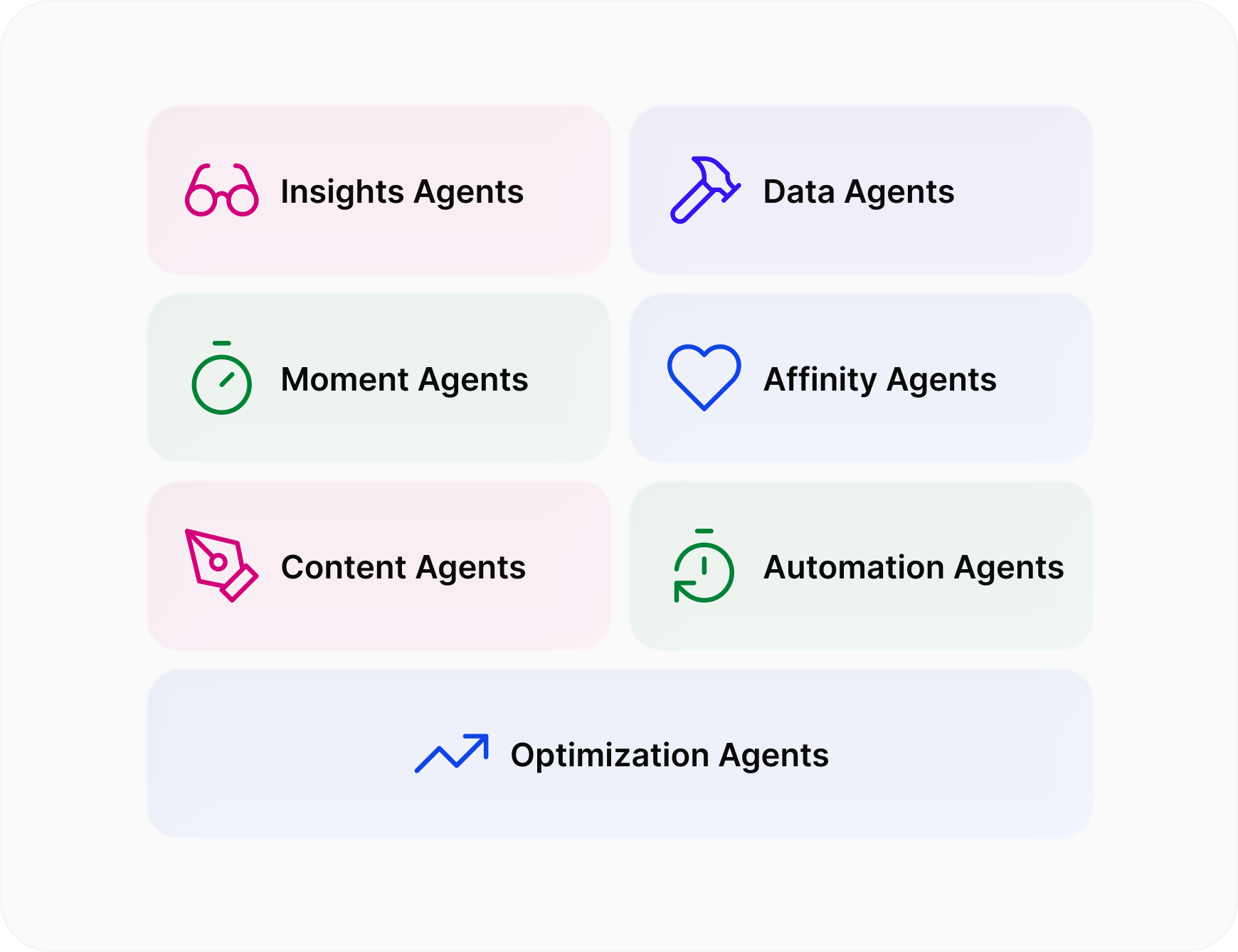
Too many agents, too little time
How can we make it as easy as possible for our users to use our AI Agents?
AI Agents work best when organized around a shared goal and context, but in the current state, Agents and their outputs are isolated from each other even if those outputs have dependencies.
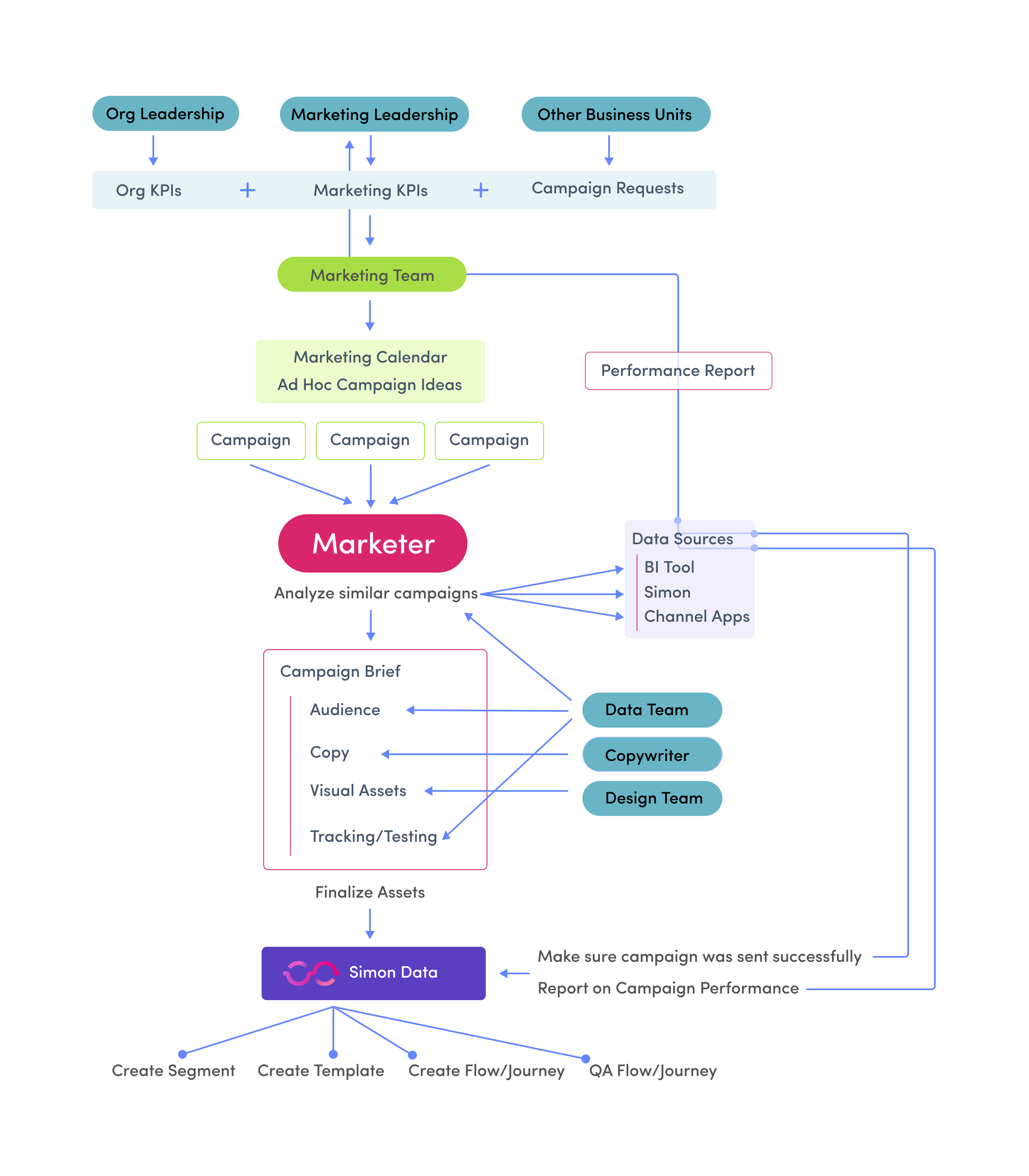
Just a small snippet of a markter’s DITL!!
Solutions
In early 2025, after user feedback from beta testers and internal testers, competitive research and a design sprint, we landed on Solution #1: Build a UI that allows the user to easily orchestrate across multiple Agents and manage outputs and context. (AKA Blueprints).
Solution #1: Blueprints
With the development of many different AI Agents doing different things with different outputs and no way to organize outputs or ability to share context between agents, it was clear that there needed to be a way to organize all of those outputs and conversations.
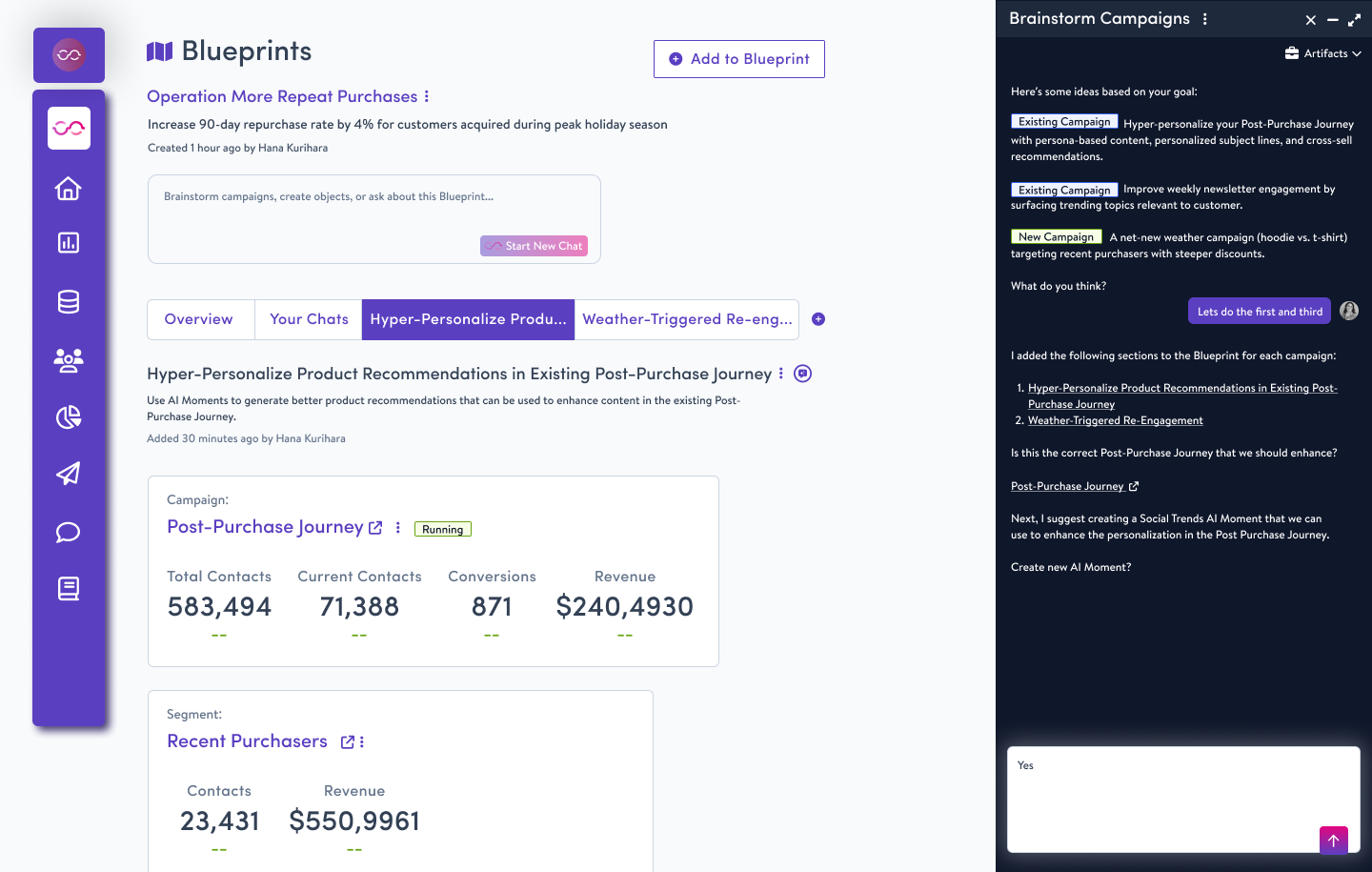
Thus, the Simon Blueprint was born. The Blueprint has two main purposes: organization and feature adoption.
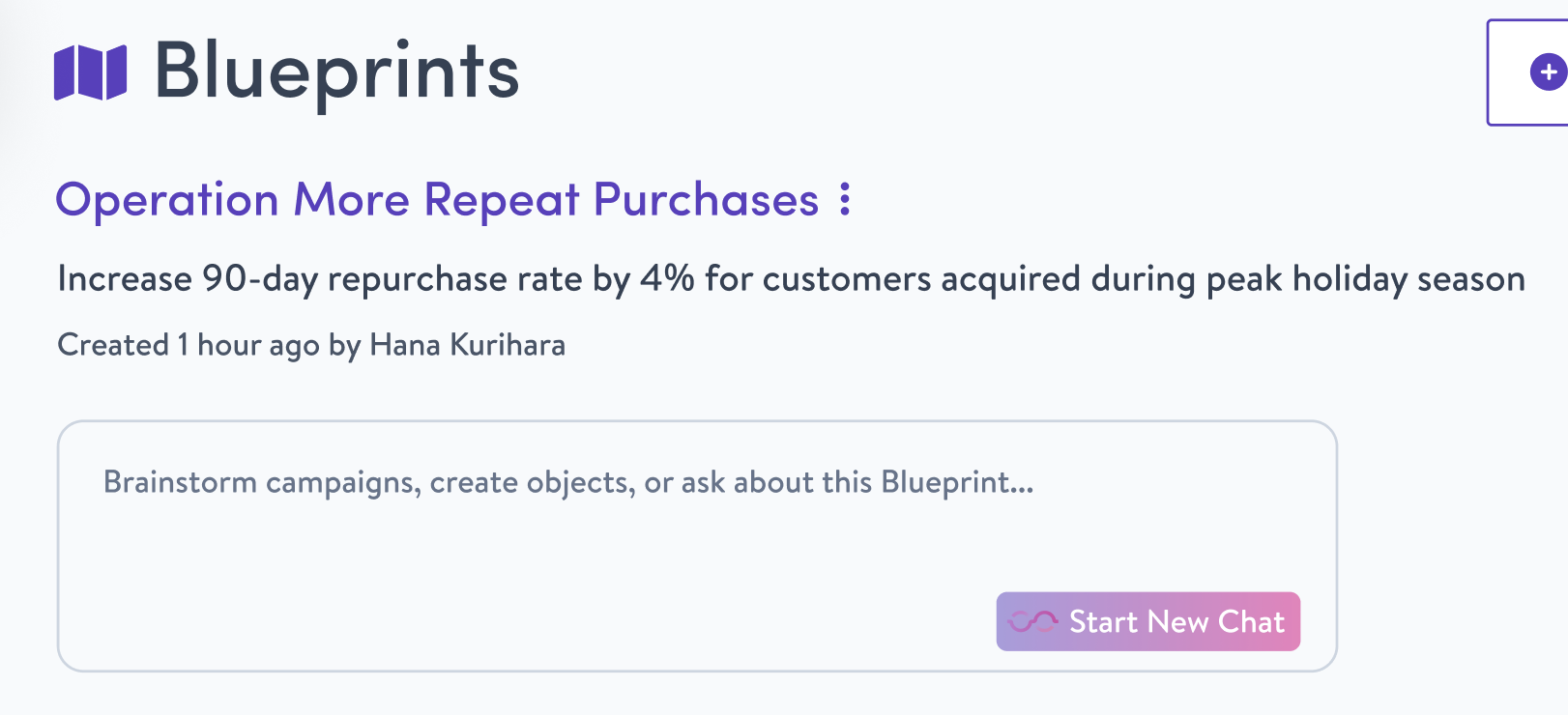
Easily organize campaigns and all of the pieces they contain under a common goal or purpose.
Organization
The Blueprint allows the user to keep track of Simon objects that are related to each other all in one .
ie. Keeping track of all of the Segments, Flows, Journeys, Templates, Content Fields, and Datasets related to your “Spring Sale Campaign Series”.
ie. Keeping track of all of Campaigns that are being sent to improve the rate of repeat purchases.
Feature Adoption
By having users start with a goal or a purpose when creating a Blueprint, it provides a way to surface different actions or strategy that Simon’s AI Suite can enable towards accomplishing the goal.
ie. The user enters the goal, “Improve Repeat Purchases” and the Blueprint surfaces new campaign ideas or ways to improve existing campaigns in addition to the steps or objects needed to launch those campaigns.
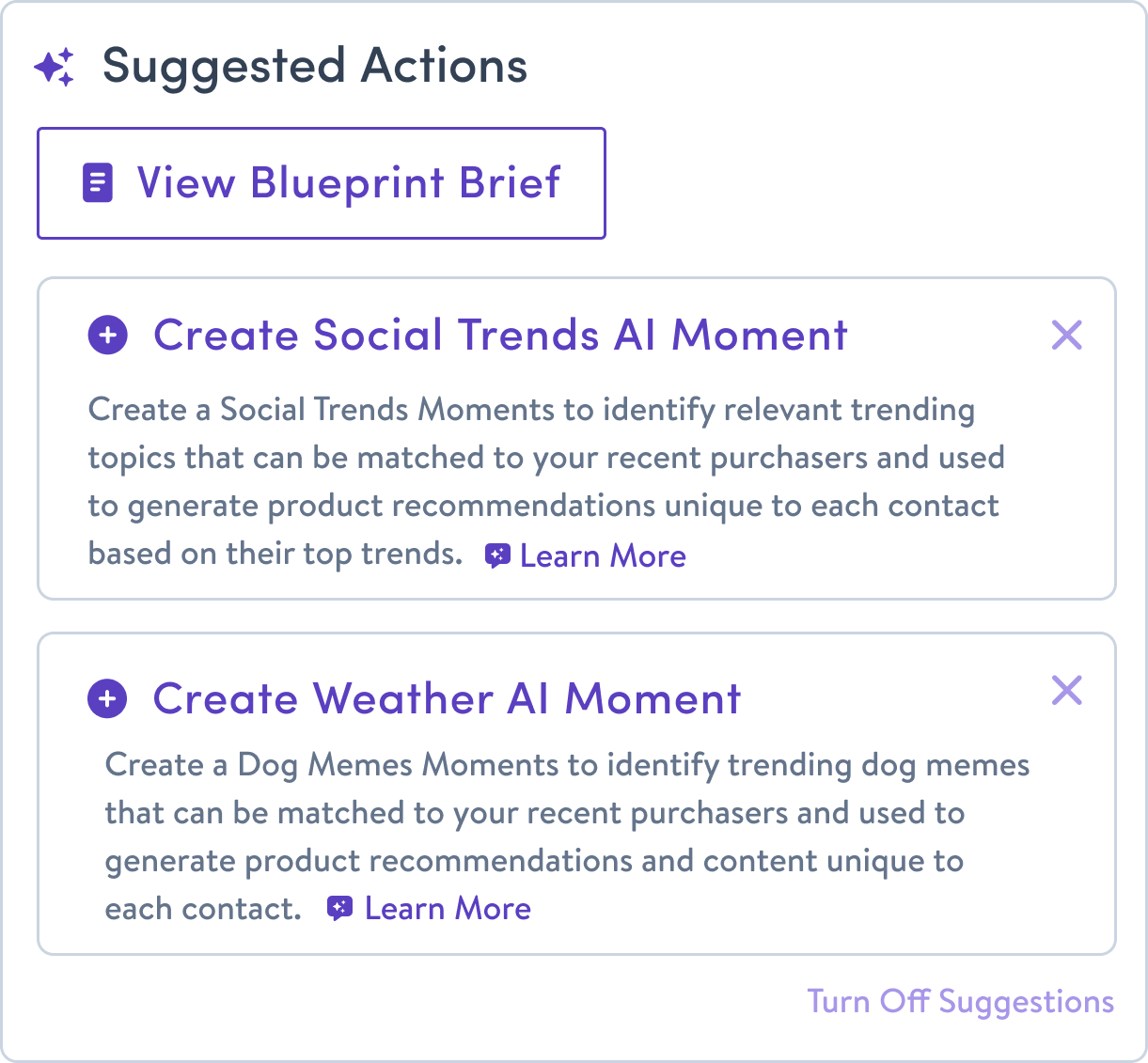
Get suggestions on how to improve your campaigns.
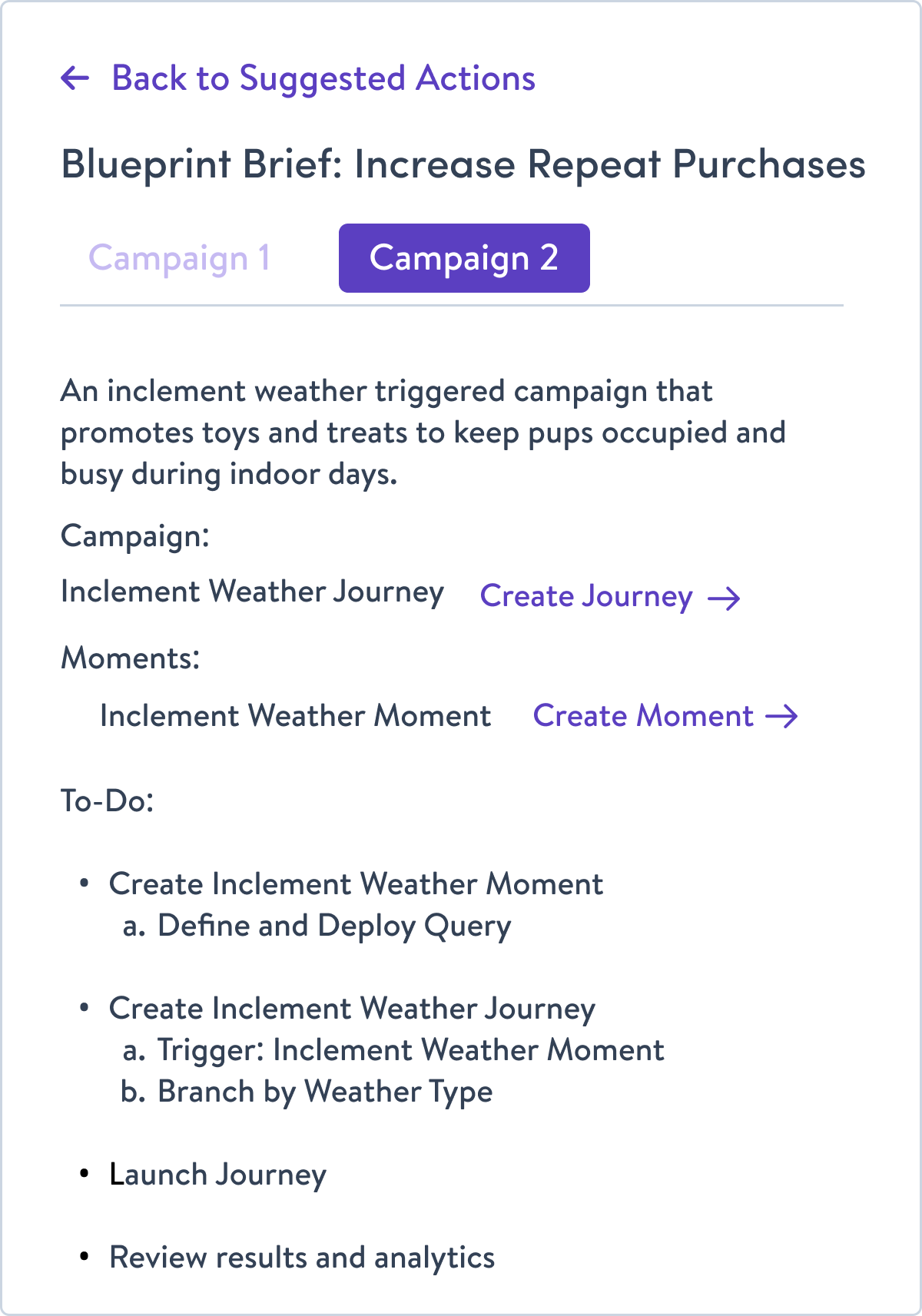
Keep track of strategy and to-do’s to get your campaigns built and launched.
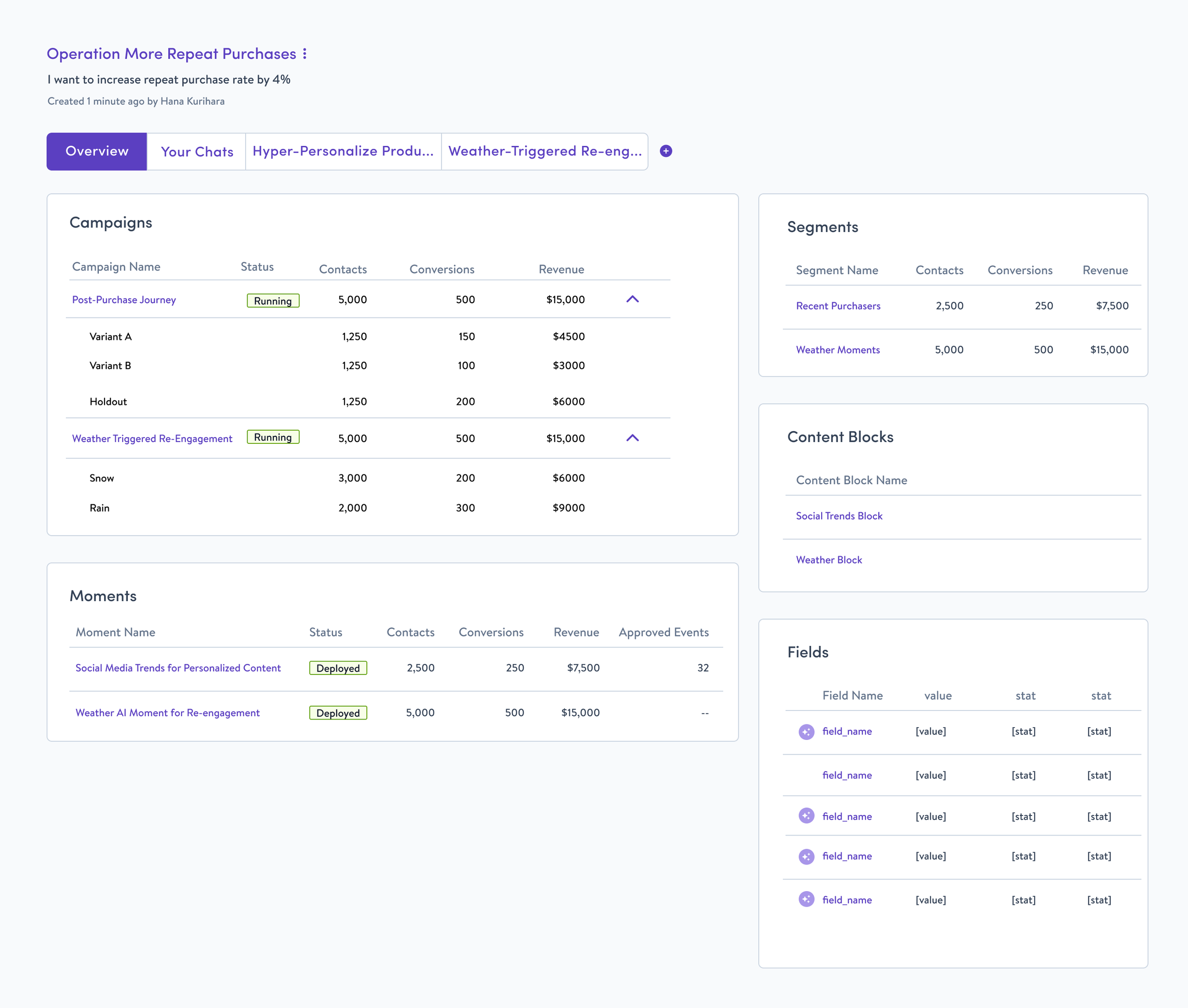
See analytics and reporting across objects and campaigns to get a clear picture of engagement.
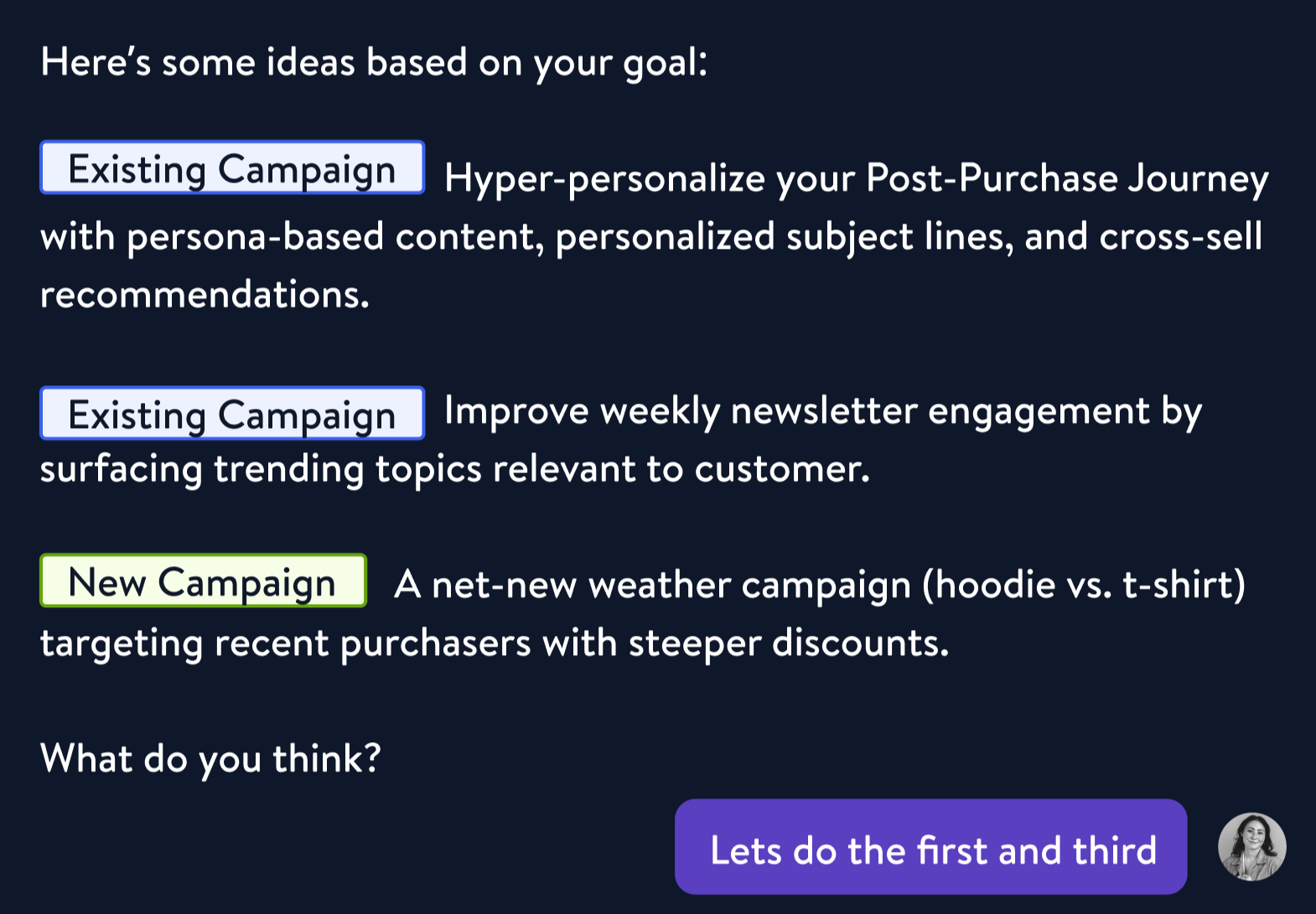
Chat with Simon AI to come up with a strategy on how to meet your Blueprint’s goal.
Solutions Continued…
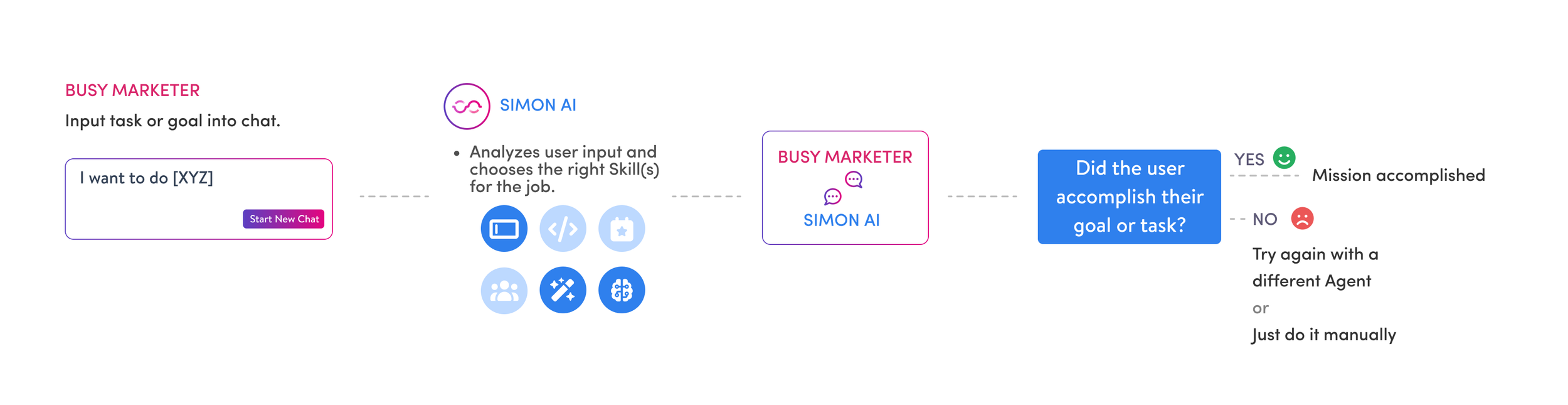
In late 2025, the AI Agents Engineering team made strides in Agent modeling and set up the infrastructure to implement Solution #2: Move to a “Super Agent” model that removes the need for the user to choose the correct Agent before starting a chat.
Solution #2: Agent Modeling
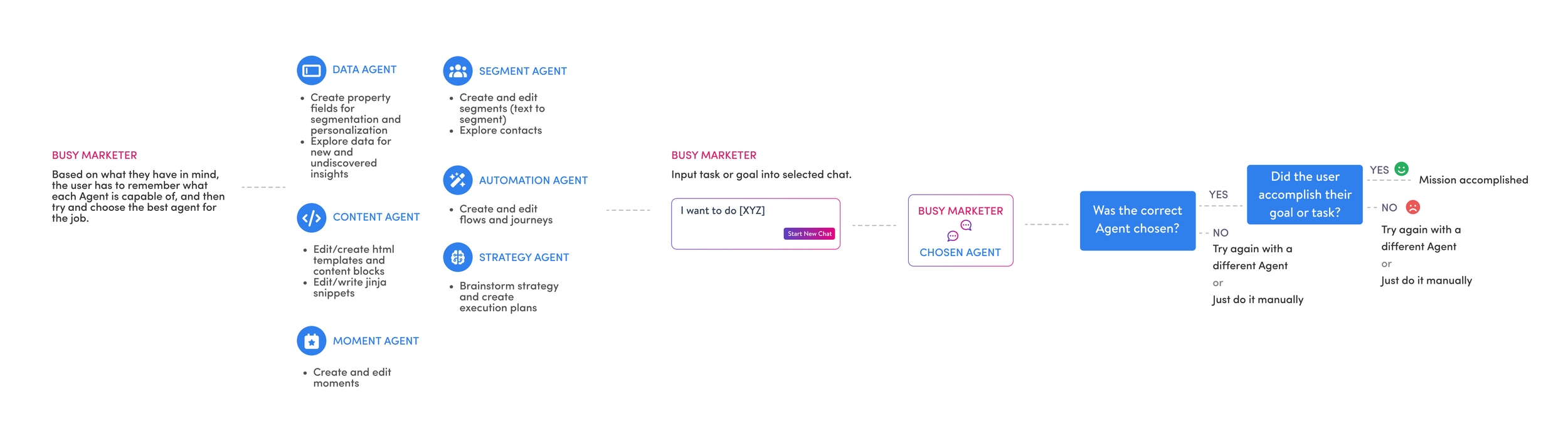
By unifying the entry points of all chat functions, the user no longer needs to know which Agent they need to chat with based on their goal. It basically allows a user to start chatting with Simon AI immediately after an idea, goal or question pops into their head.
It also simplifies the UI by removing the clutter of the many Agent names (Data Agent, Content Agent, Insights Agent, etc.) from the navigation, headers, and buttons in addition to removing the different versions of chat UIs that existed due to the parallel development of different AI Agents by different Engineering teams.

Previous User Workflow:
New User Workflow:
By moving agent/skill selection to after the user’s first message, we can reduce multiple steps and points of potential user error.
So how did it all shake out?
Engineering work on Solution #1, Blueprints, began early 2025 and continued in different phases over the course of the year. The UI for Blueprints went through numerous iteration to account for user feedback from beta testing and new Agents that were being shipped in between work on Blueprints.
Towards the end of the year, planning for Solution #2, Improved Agent Modeling, began and Blueprints went through another iteration to complement the new unified Agent Modeling. The mocks you see on this page are from the most recent iteration of Blueprints.
As of February 2026, work on both solutions continues. The PM, engineering team and I worked to group requirements into smaller deliverables in order to ship as often as possible to give us more opportunities to get more feedback throughout the development process
Thanks for reading!!

Dog tax!